• Skip to primary navigation
  • Skip to main content
  • Skip to primary sidebar
  • Skip to footer

  • Home
  • Books Read
    • Books Read
    • Books by Author
  • Cooking
  • Quilting

Books Read

The Wizard of Lies: Bernie Madoff and the Death of Trust
December 31, 2017 Filed Under: Books Read

The Wizard of Lies: Bernie Madoff and the Death of Trust

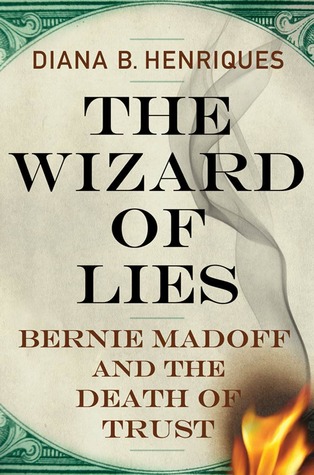
The Wizard of Lies by Diana B. Henriques
Published by Times Books on April 26, 2011
Pages: 448
Format: hardback
See it @ Goodreads


Synopsis

The inside story of Bernie Madoff and his $65 billion Ponzi scheme, with surprising and shocking new details from Madoff himself.

Who is Bernie Madoff, and how did he pull off the biggest Ponzi scheme in history?

These questions have fascinated people ever since the news broke about the respected New York financier who swindled his friends, relatives, and other investors out of $65 billion through a fraud that lasted for decades. Many have speculated about what might have happened or what must have happened, but no reporter has been able to get the full story -- until now.

In The Wizard of Lies, Diana B. Henriques of The New York Times -- who has led the paper’s coverage of the Madoff scandal since the day the story broke -- has written the definitive book on the man and his scheme, drawing on unprecedented access and more than one hundred interviews with people at all levels and on all sides of the crime, including Madoff’s first interviews for publication since his arrest. Henriques also provides vivid details from the various lawsuits, government investigations, and court filings that will explode the myths that have come to surround the story.

A true-life financial thriller, The Wizard of Lies contrasts Madoff's remarkable rise on Wall Street, where he became one of the country’s most trusted and respected traders, with dramatic scenes from his accelerating slide toward self-destruction. It is also the most complete account of the heartbreaking personal disasters and landmark legal battles triggered by Madoff’s downfall -- the suicides, business failures, fractured families, shuttered charities -- and the clear lessons this timeless scandal offers to Washington, Wall Street, and Main Street.

I am continually baffled by people whom seem to have no conscience. I am bothered by my own digressions to the point of losing sleep. How is it that people can delude themselves to think that what they are doing or what they did is not a problem. How the human mind works is just amazing. Bernie Madoff for over thirty years ran a multi-billion dollar Ponzi scheme. He fooled thousands of people and a large part of the financial sector with his scheme.

Henriques details how Madoff had a shadow business running on another floor of his company, where he faked everything from stock trades to account statements. She further details how she feels that some of Madoff’s wealthier clients may have understood what Madoff was involved in and withdrawn money because they knew they could. How Madoff was able to fool the SEC several times, mostly because I think they really didn’t want to believe that this could happen. The book deals with the efforts made to recover some of the funds that investors lost. Overall, it is an interesting read.

The author also refers to Harry Markopolos No One Would Listen who spent 10 years trying to get the SEC to really investigate Madoff. I would suggest reading this book also, Markopolos is at times a little over the top but he was spot-on when it comes to Madoff.

No Place to Hide

December 30, 2017 Filed Under: Books Read

No Place to Hide

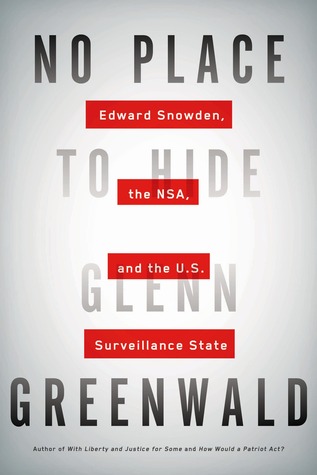
No Place to Hide: Edward Snowden, the NSA, and the U.S. Surveillance State by Glenn Greenwald
Published by Metropolitan Books/Henry Holt (NY) on May 13th 2014
Pages: 260
Format: hardback
See it @ Goodreads


Synopsis

No Place to Hide is a groundbreaking look at the NSA surveillance scandal, from the reporter who broke the story

Investigative reporter for The Guardian and bestselling author Glenn Greenwald, provides an in-depth look into the NSA scandal that has triggered a national debate over national security and information privacy. With further revelations from documents entrusted to Glenn Greenwald by Edward Snowden himself, this book explores the extraordinary cooperation between private industry and the NSA, and the far-reaching consequences of the government’s surveillance program, both domestically and abroad.

I was interested in how one person could possibly steal digital information from our government. I never really found out by reading this book. I did find out that the government has the ability to know a lot about us and our personal lives. I also decided that you would have to live totally off the grid to have any real privacy, which I don’t think is even possible to do any longer.

What interest me now is if we have such capabilities to spy on people then, we should know exactly what was happening with Trump et al. Early on in the Trump investigation wasn’t there talk of surveillance of foreign diplomats and didn’t the Obama Administration ask the courts to release information as to whom that foreign diplomat was speaking to? Did Trump collude with the Russians, I personally don’t believe he has the depth or knowledge to successfully do that.

While Greenwald makes Edward Snowden out to be the hero of the 20th century, he (Greenwald) takes to task the The Washington Post and The New York Times for going to the government for input before publishing stories about their suspicious activities implying that we never get the truth because the media and government collude to lessen the impact of these stories. Greenwald can, in my mind’s eye, be a bit self-righteous at times, but mostly he is spot on.

I wanted to read No Place to Hide prior to reading How America Lost Its Secrets by Edward Jay Epstein, whom has a totally different take on Edward Snowden and the theft of documents from the NSA apparatus.

About Glenn Greenwald

Glenn Greenwald is the author of several bestsellers, including How Would a Patriot Act? and With Liberty and Justice for Some. Acclaimed as one of the 25 most influential political commentators by The Atlantic, one of America’s top 10 opinion writers by Newsweek, and one of the Top 100 Global Thinkers for 2013 by Foreign Policy, Greenwald is a former constitutional law and civil rights litigator. He was a columnist for The Guardian until October 2013 and is now a founding editor of a new media outlet, The Intercept.. He is a frequent guest on CNN, MSNBC, and various other television and radio outlets. He has won numerous awards for his NSA reporting, including the 2013 Polk Award for national security reporting, the top 2013 investigative journalism award from the Online News Association, the Esso Award for Excellence in Reporting (the Brazilian equivalent of the Pulitzer Prize), and the 2013 Pioneer Award from Electronic Frontier Foundation. He also received the first annual I. F. Stone Award for Independent Journalism in 2009 and a 2010 Online Journalism Award for his investigative work on the arrest and detention of Chelsea Manning. In 2013, Greenwald led the Guardian reporting that was awarded the Pulitzer Prize for public service.

Website | Blog

An American Sickness: How Healthcare Became Big Business and How You Can Take It Back
December 19, 2017 Filed Under: Books Read

An American Sickness: How Healthcare Became Big Business and How You Can Take It Back

An American Sickness: How Healthcare Became Big Business and How You Can Take It Back by Elisabeth Rosenthal
Published by Books on Tape on April 11th 2017
See it @ Goodreads


Synopsis

A New York Times bestseller.

At a moment of drastic political upheaval, An American Sickness is a shocking investigation into our dysfunctional healthcare system - and offers practical solutions to its myriad problems.

In these troubled times, perhaps no institution has unraveled more quickly and more completely than American medicine. In only a few decades, the medical system has been overrun by organizations seeking to exploit for profit the trust that vulnerable and sick Americans place in their healthcare. Our politicians have proven themselves either unwilling or incapable of reining in the increasingly outrageous costs faced by patients, and market-based solutions only seem to funnel larger and larger sums of our money into the hands of corporations. Impossibly high insurance premiums and inexplicably large bills have become facts of life; fatalism has set in. Very quickly Americans have been made to accept paying more for less. How did things get so bad so fast?

Breaking down this monolithic business into the individual industries--the hospitals, doctors, insurance companies, and drug manufacturers--that together constitute our healthcare system, Rosenthal exposes the recent evolution of American medicine as never before. How did healthcare, the caring endeavor, become healthcare, the highly profitable industry? Hospital systems, which are managed by business executives, behave like predatory lenders, hounding patients and seizing their homes. Research charities are in bed with big pharmaceutical companies, which surreptitiously profit from the donations made by working people. Patients receive bills in code, from entrepreneurial doctors they never even saw.

The system is in tatters, but we can fight back. Dr. Elisabeth Rosenthal doesn't just explain the symptoms, she diagnoses and treats the disease itself. In clear and practical terms, she spells out exactly how to decode medical doublespeak, avoid the pitfalls of the pharmaceuticals racket, and get the care you and your family deserve. She takes you inside the doctor-patient relationship and to hospital C-suites, explaining step-by-step the workings of a system badly lacking transparency. This is about what we can do, as individual patients, both to navigate the maze that is American healthcare and also to demand far-reaching reform. An American Sickness is the frontline defense against a healthcare system that no longer has our well-being at heart.

An American Sickness is a frightening book as it lays out how dysfunctional the US medical system has become.

Overall, CMS projected that total health care spending for 2016 reached nearly $3.4 trillion, up 4.8 percent from 2015. According to CMS, U.S. health care spending is projected to reach nearly $5.5 trillion by 2025. The agency attributed the increase in large part to the United States’ aging population and rising prices for health care services.
According to the report, national health care spending is projected to outpace growth in the United States’ Gross Domestic Product (GDP) by 1.2 percentage points. As a result, CMS estimated that health care spending will account for 19.9 percent of GDP by 2025, up from 17.8 percent in 2015.
[1. CMS: US health care spending to reach nearly 20% of GDP by 2025 ]

Rosenthal lists of 10 Economic Rules that she sees govern the Dysfunctional U.S. Medical Market.

  1. More treatment is always better. Default to the most expensive option.
  2. A lifetime of treatment is preferable to a cure.
  3. Amenities and marketing matter more than good care.
  4. As technologies age, prices can rise rather than fall.
  5. There is no free choice. Patients are stuck. And they’re stuck buying American.
  6. More competitors vying for business doesn’t mean better prices; it can drive prices up, not down.
  7. Economies of scale don’t translate to lower prices.
  8. There is no such thing as a fixed price for a procedure or test. And the uninsured pay the highest prices of all.
  9. There are no standards for billing. There’s money to be made in billing for anything and everything.
  10. Prices will rise to whatever the market will bear. The mother of all rules!

Through out the book she refers to these rules, as she educates on out of network fees, facility fees, old drugs that become exorbitantly expensive for no other reason than profit. Tests, Electronic Medical Records, pharmaceuticals, billing codes have all become a way to ease more money out of us with not relate improvement in medical care.

The book is overwhelming in its look at the current medical system in the United States, the Republicans want to cut back on both private and government insurances, telling us that we need to shop around for the best price (which isn’t always possible) and totally impractical with the current system. While health care might be more readily available in say Marin County, California health care may be very limited in say Bonner’s County, Idaho.

It is a fascinating book, for me it made it all the more clear that a single payer system would be best. That getting sick in this country is scary, I don’t really see the suggestions for taking back our medical system working out any time in the near future. I do not trust politicians to be doing what is best for patients, business interests will always come first. Despite what Raul Ryan keeps telling us Medicare is not going broke today or tomorrow and there are methods to fix it.

About Elisabeth Rosenthal

Authors - Elisabeth-Rosenthal

Dr. Elisabeth Rosenthal was for twenty-two years a reporter, correspondent, and senior writer at The New York Times before becoming the editor in chief of Kaiser Health News, an independent journalism newsroom focusing on health and health policy. She holds an MD from Harvard Medical School, trained in internal medicine, and has worked as an ER physician. She lives in New York City and Washington, DC.

Website | Blog | Facebook

« Previous Page
Next Page »

Primary Sidebar

April 2026
S M T W T F S
 1234
567891011
12131415161718
19202122232425
2627282930  
« Jan    
Deer Park
Current weather
-º
Sunrise-
Sunset-
Humidity-
Wind direction-
Pressure-
Cloudiness-
Deer Park weather

2024 Reading Challenge

2024 Reading Challenge
The Pfaeffle Journal (Diane) has read 12 books toward her goal of 35 books.
hide
12 of 35 (34%)
view books

Pocket

  • Speaker Johnson Works to Unite Fractious Republicans Behind Him

  • Brandon Sanderson Is Your God

  • How Christian Is Christian Nationalism?

Other Books Read

Genealogy of a Murder: Four Generations, Three Families, One Fateful Night

Homegrown: Timothy McVeigh and the Rise of Right-Wing Extremism

Long Shadows

Footer

Currently Reading

Publishing Soon

The Missing Half The Missing Half by Ashley Flowers
Close Your Eyes and Count to 10 Close Your Eyes and Count to 10 by Lisa Unger
Goodreads

Copyright © 2026 · WordPress · Log in